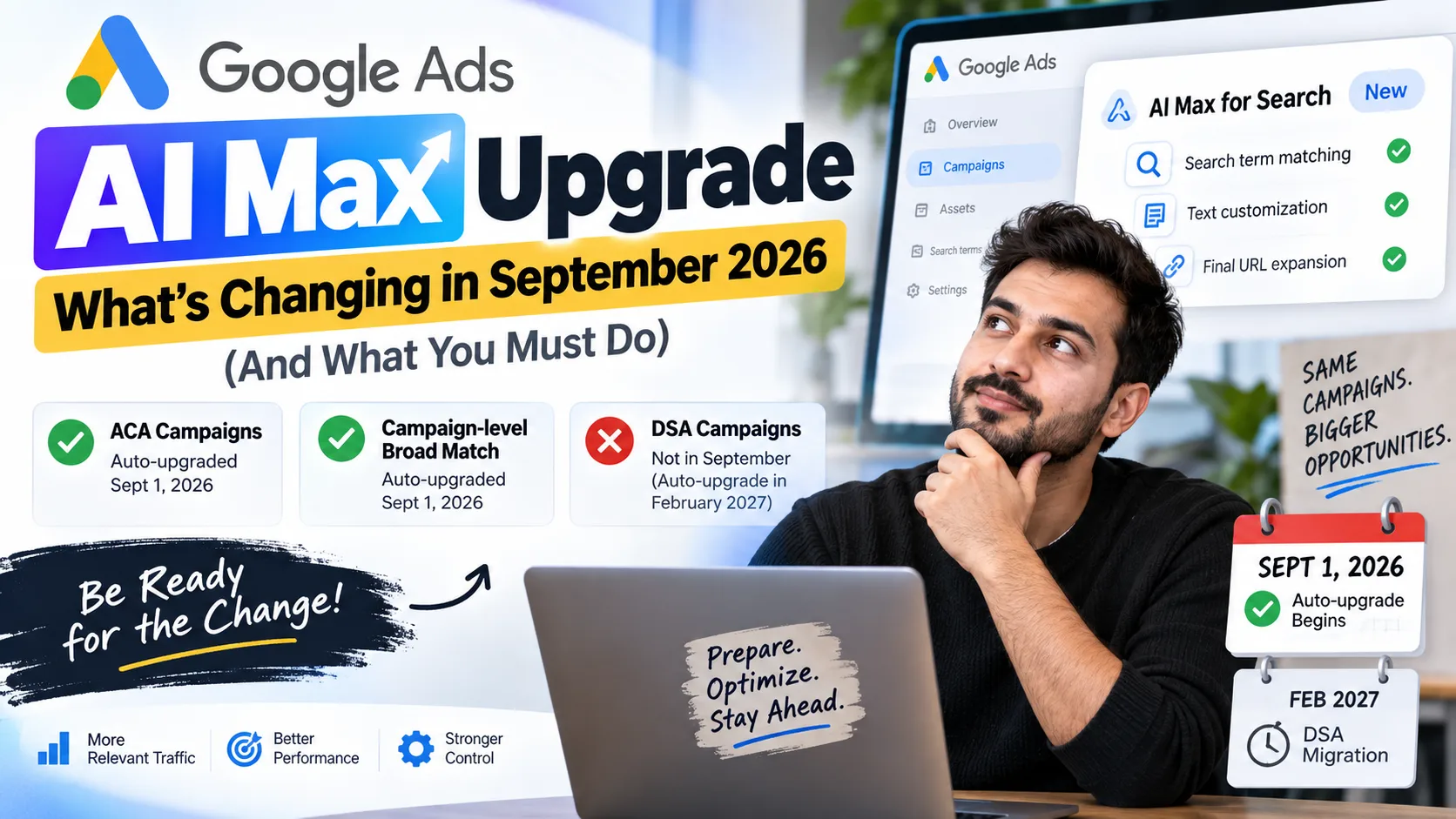
Starting September 1, 2026, Google is automatically upgrading Google Ads campaigns that use Automatically Created Assets (ACA) or campaign-level broad match settings to AI Max for Search — with the upgrade targeted for completion by the end of September 2026. Dynamic Search Ads (DSA) campaigns are not part of this September change — Google extended the DSA migration deadline to February 2027 after advertiser feedback about Q4 planning risk. Below is exactly what’s changing, what stays the same, and the checklist to run before the auto-upgrade reaches your account.
What Is AI Max for Search?
AI Max for Search is Google’s next-generation search campaign feature set — the evolution of Dynamic Search Ads. It combines your existing keywords and assets with real-time intent signals to find additional relevant queries, while keeping advertiser controls (brand exclusions, URL rules) in place. It is built from three features that can each be controlled independently:
- Search term matching — uses broad match and keywordless technology to find relevant, high-performing queries beyond your existing keyword list. Controlled at the ad group level (on/off toggle), with “locations of interest” targeting, brand inclusions at campaign and ad group level, and brand exclusions at the campaign level.
- Text customization — generates ad copy by combining your existing ad text, landing page content, and assets with generative AI to better match specific searches. Controlled at the campaign level; generated assets can be reviewed in optimized asset reports and removed individually.
- Final URL expansion — automatically routes traffic to the page on your domain predicted to perform best for a given query. Requires text customization to be enabled, and is controlled at the campaign level with URL inclusion and exclusion rules.
What’s Actually Changing on September 1, 2026
Two specific legacy setups get automatically upgraded to AI Max starting September 1, 2026, with completion targeted by end of month:
- Campaigns using Automatically Created Assets (ACA)
- Campaigns using campaign-level broad match settings
If your account uses either of these, Google migrates the legacy settings into standard ad groups with all three AI Max features enabled, while preserving your existing legacy URL controls. During the transition, your current ads keep running while the new AI Max-generated Responsive Search Ads are created and go through policy review — Google’s stated goal is no gap in traffic during the switch.
What’s Different for Dynamic Search Ads (DSA)
This is the part most Shopify advertisers get wrong: DSA campaigns are on a separate, later timeline. Google’s original plan (announced April 15, 2026) had DSA auto-upgrading around the same September window. After advertiser pushback about migrating live campaigns heading into Q4, Google published an update on the Ads Developer Blog in June 2026 extending the DSA timeline:
| Date | What Happens |
|---|---|
| April 15, 2026 | Original AI Max transition plan announced |
| June 2026 | DSA deadline extended; DSA campaign creation fully restored (create/edit as normal) |
| June 2026 – January 2027 | Extended window to voluntarily test and migrate DSA to AI Max |
| September 1, 2026 | Auto-upgrade begins for ACA and campaign-level broad match campaigns |
| January 2027 | Creating new DSA campaigns is no longer possible |
| February 2027 | Automatic migration begins for remaining DSA campaigns |
In short: if your Shopify store runs plain DSA campaigns with no ACA or campaign-level broad match enabled, nothing forces a change on September 1 — you have until February 2027, and can still create new DSA campaigns until January 2027.
The One Thing Most Advertisers Miss
The auto-upgrade migrates your existing settings — it does not audit or fix them. If your account is missing brand exclusions, has outdated URL exclusions, or never had “locations of interest” configured, those gaps carry over into AI Max untouched. For a Shopify store, this commonly means: irrelevant broad-match queries triggering ads, or final URL expansion sending traffic to old/discontinued collection or product pages if URL exclusions were never set.
Pre-Upgrade Checklist for Shopify Advertisers
- Check if ACA or campaign-level broad match is enabled in any active campaign — these are the ones affected on September 1.
- Review and add brand exclusions at the campaign level before the upgrade, so search term matching doesn’t pull in unwanted brand or competitor queries.
- Set URL exclusions for any discontinued products, out-of-stock collections, or pages you don’t want final URL expansion routing traffic to.
- Decide on DSA campaigns separately — you’re not forced to act by September 1, but voluntarily migrating during the extended window lets you test AI Max with lower risk than waiting for the February 2027 forced migration.
- Benchmark current performance (conversions, CPA, ROAS) before the upgrade so you have a clean before/after comparison once AI Max is active.
Does AI Max Actually Perform Better?
According to Google’s own data, AI Max for Search campaigns using the full feature suite (search term matching, text customization, and final URL expansion together) see an average of 7% more conversions or conversion value at a similar CPA/ROAS compared to using search term matching alone — a figure Google attributes specifically to non-retail advertisers. Shopify sellers should treat this as a directional signal, not a guarantee, and validate results against their own account after the upgrade rather than assuming the same lift applies to a retail catalog.
Frequently Asked Questions
What changes in Google Ads on September 1, 2026?
Google begins automatically upgrading campaigns that use Automatically Created Assets (ACA) or campaign-level broad match settings to AI Max for Search, with the upgrade targeted for completion by the end of September 2026.
Are Dynamic Search Ads (DSA) campaigns upgraded on September 1, 2026?
No. Google extended the DSA migration deadline to February 2027 in a June 2026 update. DSA campaign creation was also restored, and advertisers can continue creating new DSA campaigns until January 2027.
Will my account settings be preserved during the AI Max upgrade?
Yes, for the most part — Google preserves your legacy URL controls during the migration. However, it does not add missing controls like brand exclusions, so any gaps in your current setup carry over unchanged.
Can I opt out of the September 2026 auto-upgrade?
Google has not published an opt-out mechanism for the ACA and campaign-level broad match upgrade — it applies automatically to eligible campaigns. DSA campaigns, however, can still be voluntarily migrated on your own timeline before the February 2027 deadline.
Running paid ads on more than one platform? See our guide on how to run your first Meta Ads campaign for the Shopify-specific setup, budget formula, and common mistakes to avoid.
Not sure if your Shopify store’s ad account is affected? Get a free Shopify store audit covering Google Ads setup, Meta Ads, and conversion tracking. You can also see my Meta and Google Ads services for hands-on setup and tracking help.
Leave a Reply